

Your California deed,
without a reassessment
Putting a name on a property — or taking one off — comes down to choosing the deed that does the job without triggering a property-tax reassessment. The wrong choice can cost thousands a year or leave a defect on your title. You tell us what you want to do; we prepare the deed you choose, file the matching exemption form, and e-record it the same day.
Last updated June 2026
What each deed costs
Published flat fees, confirmed before any work begins. Find your document below.
What happens after you click
- A ten-minute form online — you tell us which document fits. No payment to start.
- We review it, confirm your fee, and email a secure payment link.
- You sign with any notary in California, another state, or overseas — you never come to our office.
- E-recorded with your county the same business day — stamped copy emailed to you.
Add-ons where the file calls for them: same-day e-recording +$50 · title search +$30 · notary +$15 per signature. County recording fees are collected at cost and paid to the county. See the full fee schedule →

About Quinnie Do
Quinnie Do founded TruPoint Legal LLC and holds three California professional credentials — Registered Legal Document Assistant, Registered IRS Tax Preparer, and Commissioned Notary Public. A native Vietnamese speaker, she leads a trilingual team serving English, Vietnamese, and Spanish-speaking clients across all 58 California counties. On deeds: Quinnie has prepared and e-recorded California property deeds for homeowners, families, and referral partners throughout Santa Clara County and the wider Bay Area.
What each California deed does
Most Californians putting a name on a property title — or taking one off — face the same first question: which deed does the job, a grant deed, a quitclaim, an interspousal, or a trust transfer. As of 2026, California real estate attorneys typically charge $1,000–$2,000 to prepare a single deed. TruPoint Legal prepares every California deed type as a Santa Clara County–registered Legal Document Assistant. Each deed is a flat $325 — $400 for an LLC or corporation transfer — with the Preliminary Change of Ownership Report and the matching exemption claim prepared alongside it. We e-record the same day in all 58 California counties, prepared by Quinnie Do, LDA #268 (verify ↗).
Five reasons people change a title
Homeowners & families
If you’re adding a spouse, removing an ex, gifting to a child, or moving a home into your trust, these are non-sale transfers we prepare at your direction — without an escrow sale.
Attorneys
If you handle divorce or probate and need a clean deed prepared and recorded to finish a matter, we prepare it to your direction on a flat fee.
Title & escrow
If you can’t record a trust or out-of-escrow deed as an accommodation, you can refer the recording to us and keep the liability off your desk.
Realtors & brokers
If a past client needs a non-sale transfer — add a spouse, remove an ex, fund a trust, move a property to an LLC — we prepare and record it.
Lenders
If a refinance, transfer-on-death, or deed of trust has to record by a wire-funding deadline, we e-record the same day in the right county.
A deed is cheap. The wrong one isn’t
The form costs a few hundred dollars. The consequences of the wrong deed — or a missed exemption form — can follow the property for as long as you own it. Here’s what’s actually at stake.
A reassessment you didn’t expect
Skip the exemption claim that goes with a parent-to-child or spousal transfer and the county can reset your taxable value to today’s market price — often $11,000–$15,000 a year in added property tax.
A title you can’t sell cleanly
Take a quitclaim in a purchase and you get no promises about the title. Clearing the problem later can mean a quiet-title action that runs $5,000 and up.
A deed the recorder bounces
Wrong margins, a missing change-of-ownership report, or an unsigned acknowledgment get a deed rejected — days to weeks of delay, sometimes past a closing or funding deadline.
Every California deed, and what it does
California really uses two base deeds — the grant deed and the quitclaim deed. The rest are those two customized for a specific situation. Here’s the plain-English version, with the tax note that matters most.
| Deed | What it does | Common use | Title protection | Tax / reassessment note |
|---|---|---|---|---|
| Grant deed | Transfers ownership with two built-in promises: the owner hasn’t already sold it, and there are no hidden liens. | Most sales; adding or changing a name on title. | Medium | A sale can trigger transfer tax and reassessment; family transfers may use an exclusion. |
| Quitclaim deed | Transfers only whatever interest the signer has, with no promises about the title. | Divorces, family transfers, gifts, clearing a title cloud. | None | No transfer tax when no money changes hands, between spouses, or into a trust. |
| Interspousal transfer deed | Moves property between spouses or registered partners and states the community-property intent. | Adding a spouse after marriage; removing one after divorce. | Grant-style | Excluded from reassessment and exempt from transfer tax. |
| Trust transfer deed | Moves a property into or out of your revocable living trust. | Funding an estate plan so the home avoids probate. | Grant-style | Transfers to your own revocable trust are generally excluded from reassessment. |
| Entity deed (LLC/Corp) | Moves property to or from a company you own. | Holding a rental in an LLC; contributing property to a corporation. | Grant or quitclaim | A change in who controls the entity is reported on form BOE-100-B and may reassess; some transfers that don’t change ownership shares are excluded. |
| Corrective deed | Re-records an existing deed to fix an error, such as a misspelled name or wrong legal description. | Fixing a typo or omission found after recording. | Matches original | A true correction isn’t a new transfer, so it generally doesn’t reassess. |
| Affidavit of Death of Joint Tenant | A recorded sworn statement that removes a deceased joint tenant so the survivor holds title alone. | A co-owner dies and title was held in joint tenancy. | Not a transfer | The survivor may qualify for the cotenant residency exclusion on form BOE-58-H when they co-owned and co-resided for the year before the death. |

Grant vs. quitclaim, in one line
A grant deed carries two implied promises about the title; a quitclaim carries none. Grant deeds fit sales and most name changes. Quitclaims fit transfers between people who already trust each other. We prepare either — you decide which fits your situation.
The “customized” deeds
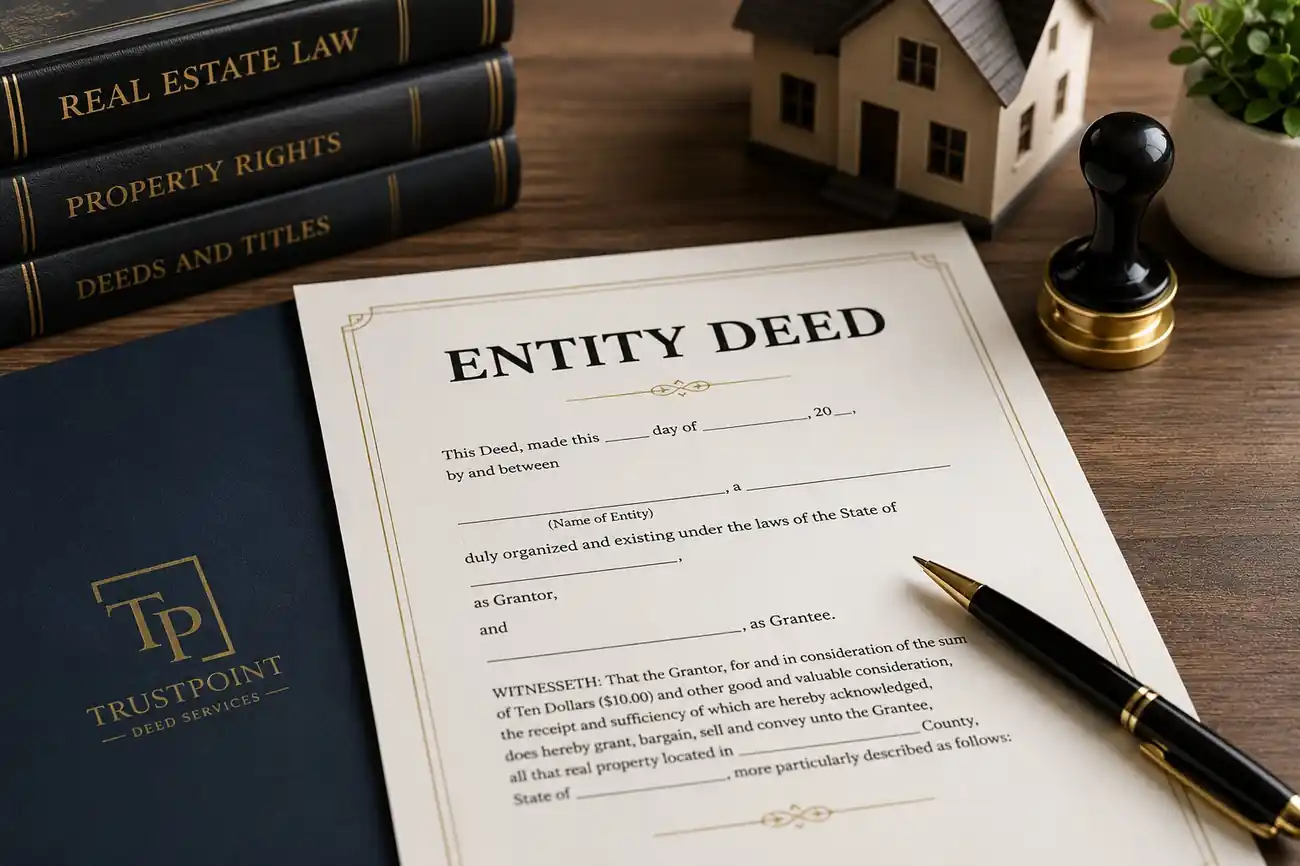
Interspousal, trust transfer, and entity deeds are grant or quitclaim deeds adapted to a specific move — between spouses, into a trust, or to a company. Each carries its own exemption form, which is where most do-it-yourself filings go wrong. See all deed services →

Fixing a recorded deed
If a recorded deed has a misspelled name or the wrong legal description, a corrective deed re-records it correctly. A true correction isn’t a new transfer, so it generally doesn’t reset your taxable value. Start a correction →

Removing a deceased co-owner
When a joint tenant dies, an Affidavit of Death of Joint Tenant, recorded with a certified death certificate, takes them off title so the survivor holds it alone. A surviving co-owner who lived there may keep the existing taxable value with form BOE-58-H. Start this filing →
The forms that keep your taxes down
The deed moves the property; a separate claim form is what keeps the county from reassessing it. Which form your transfer needs depends on the situation — we walk you through the options and prepare the one that applies.
Parent to child
A child taking a parent’s home can keep the existing taxable value when they move in as a primary residence within one year and file within three years. The first $1,044,586 above the parent’s existing value stays protected (the cap California set through February 15, 2027).
Grandparent to grandchild
The same exclusion is available from grandparent to grandchild, but only when all of the grandchild’s parents who were children of that grandparent have passed away. Same occupancy and filing rules apply.
Surviving co-owner (cotenant residency)
When two people own a home 100% together and one dies, the survivor can keep the existing taxable value — if both were owners of record and lived there together for the one year before the death. The survivor signs this affidavit under penalty of perjury.
Legal entity (LLC / corporation)
When property sits in a company, a change in who controls that company is reported to the state within 90 days — even when an exclusion applies. Transfers of company interests solely between spouses are excluded from reassessment.
Church, religious & nonprofit
A church or qualifying nonprofit can apply to exempt property it owns and uses for worship or charitable purposes — the Religious Exemption, the Welfare Exemption, or the Church Exemption. These are property-tax exemptions a qualifying organization claims, separate from a deed transfer.
The county transfer tax
This is a government tax, not a TruPoint fee, and it applies only on a true change of ownership. Transfers between spouses, into your own trust, and from parent to child are commonly exempt — the exemption has to be stated on the deed itself.
TruPoint prepares the deed and the exclusion form that goes with it. We describe what each exemption does and the conditions it carries; which one applies to your transfer is yours to confirm, and we prepare whichever you direct.
Published prices, no surprises
Optional add-ons
Add-ons are prepared only when your transfer calls for them, or when you request them — never bundled in.
- Same-day e-recording +$50
- Title search (pre-recording) +$30
- Parent-child / grandparent exclusion (BOE-19-P) +$100
- Base-year-value transfer forms (Prop 13) +$100
- Transfer affidavit, where applicable +$50
- In-office notary, per signature +$15
- Homestead declaration +$15
- County recording fee $40–$130 est.
Where do-it-yourself deeds go wrong
A blank form is easy to find. Pairing a deed with the correct exemption form and getting it accepted on the first try is where it gets expensive. The most common misses:
The wrong deed for the job
A quitclaim used in a purchase leaves the buyer with no title protection. Untangling it later can mean a quiet-title action that runs $5,000 and up.
A missed exemption claim
Forget the parent-child or spousal exclusion form and the county reassesses to market value — $11,000–$15,000 a year in added tax, for as long as you own the home.
A deed the recorder rejects
Wrong margins, a missing change-of-ownership report, or a bad acknowledgment get a deed bounced — days to weeks of delay, sometimes past a deadline.
An entity move that reassesses
Putting a rental into an LLC without the right reporting can trigger reassessment and a permanently higher tax base on the property.
An error that needs re-recording
A misspelled name or wrong legal description means a corrective deed later — a second filing and a clouded title in the meantime.
No one to ask
A template can’t tell you which deed fits. We walk you through your options — you decide which one fits, and we prepare it correctly the first time.
Three steps, start to recorded

Tell us
Complete a short intake questionnaire with the property and what you’d like to do — add a spouse, move it into your trust, remove a deceased owner. You select the document; we prepare it from there.

Prepare
We prepare the deed, the change-of-ownership report, and the matching exemption claim, and arrange in-office notarization of the signatures.

Record
We e-record with the county the same day in any of California’s 58 counties and send you the recorded deed once the county returns it.
First, confirm what’s on title
Not sure who currently holds title, or whether a lien is recorded against the property? Run a property title report first to confirm the owner of record and any recorded liens before you choose your deed.
Every deed needs a notarized signature
Before a deed can record, the signatures have to be notarized. Our sister office, Fingerscan Digital, handles in-office notarization the same day — so signing and recording can happen in a single visit.
Deed questions, answered
An interspousal transfer deed adds a spouse to title without an escrow sale and qualifies for the spousal exclusion from reassessment. A quitclaim or grant deed can do the same transfer, but the interspousal deed makes the community-property intent clear. TruPoint prepares the deed and the exclusion form together for a flat $325.
No — a quitclaim deed transfers only whatever interest the signer has and makes no promises about the title. That’s why quitclaims fit transfers between people who already trust each other, like family or a divorce, and why a grant deed is the standard for a purchase.
A quitclaim or interspousal transfer deed removes a former spouse from title once the divorce judgment directs it. The transfer between spouses is exempt from transfer tax and excluded from reassessment. We prepare and e-record the divorce deed transfer for you.
Yes — the parent-child exclusion, filed on form BOE-19-P, can keep your existing taxable value if your child moves into the home as a primary residence within one year. The first $1,044,586 above your current taxable value is protected through February 15, 2027. We prepare the deed and the exclusion claim together.
An Affidavit of Death of Joint Tenant, recorded with a certified death certificate, removes a deceased joint tenant so the survivor holds title alone. A surviving co-owner who lived in the home with the deceased for the year before the death may keep the existing taxable value with form BOE-58-H.
A grant deed includes two implied promises — that the owner hasn’t already sold the property and that there are no hidden liens. A quitclaim deed includes none and transfers only whatever interest the signer happens to have. Grant deeds fit sales; quitclaims fit trusted-party transfers.
TruPoint prepares any California deed for a flat $325, or $400 for an LLC or corporation transfer, plus the county’s recording fee. Optional items like same-day e-recording or an exemption form are added only when your transfer needs them or you request them.
TruPoint e-records the same day in all 58 California counties, and the county returns the recorded deed after it processes the filing. Same-day e-recording is the fastest route and avoids the delay of mailing paper to the recorder.
No — a registered Legal Document Assistant can prepare and record California deeds at your direction for a flat fee. An LDA prepares the documents you choose; for legal advice or a contested matter, a licensed attorney is the right choice. What a Legal Document Assistant does →
A trust transfer deed, conveying the property from you as an individual to yourself as trustee, naming the trust exactly as the trust document names it including its date. Signing a trust does not move the house into it — an unfunded trust is the most common reason families end up in probate anyway. If your trust came from an online service you may also be missing a certification of trust, which is what banks and escrow ask for. Flat $325 per property.
Usually the same deed, prepared correctly — a rejection is a formatting or content problem, not a sign you picked the wrong instrument. The common causes are a legal description copied from the tax bill instead of the recorded deed, an incomplete notary acknowledgment, a missing documentary transfer tax declaration or exemption statement, no Preliminary Change of Ownership Report attached, or margins outside the recorder’s format rules. A correction deed is different again — that fixes an error in a deed that already recorded.
You can, and for a simple transfer it sometimes works. The failures we get called about are consistent: the template was written for another state, the exemption recital was left blank or worded generically, the legal description was copied off the tax bill, or the vesting did not match what the family intended. A rejected deed costs you a week. A deed that records with a failed exemption is worse, because the reassessment notice arrives months later and by then the deed is on the public record.
A grant deed with the correct entity authority recital, prepared as an entity deed at a flat $400. The entity has to exist and be in good standing before the deed is prepared, because the deed names it as grantee. Entity transfers have their own change-in-ownership rules for property tax purposes that depend on ownership percentages, so take advice from a CPA before you sign — we prepare the deed and the Preliminary Change of Ownership Report, we do not advise on the tax outcome.
Yes, at the same flat fee no matter where you are. We prepare the deed and email it with signing instructions. From another state you sign before any notary public licensed where you live, scan it back to us, and we e-record it with the California county. From outside the country the acknowledgment is normally taken at a U.S. embassy or consulate, and California also accepts a notary of that country, though some counties want the signature authenticated first. You never travel to California.
The current recorded deed, or the property address and APN so we can pull it; the exact legal names of everyone giving and receiving the property; how the new owners want to hold title; and whether the transfer is a gift, a sale, a divorce transfer, or a move into a trust or entity, because that determines which deed applies and which exemption we claim. If you are not sure which deed you need, that is fine — describe the situation and we will tell you before you pay anything.
Only where the properties sit in the same county and the transfer is identical for each. Separate counties always mean separate deeds, because each one records with its own recorder. In practice we usually prepare a separate deed per property even within a county, since it keeps the record clean and makes a later sale of one property simpler. Tell us how many properties and which counties and we will quote the set before you commit.
Ready to prepare your deed?
Complete a short intake questionnaire with the property and what you’d like to do with the title. You select the document; we prepare it at a published flat fee and e-record it the same day. Prefer to talk it through first? Schedule a consultation — no obligation.