
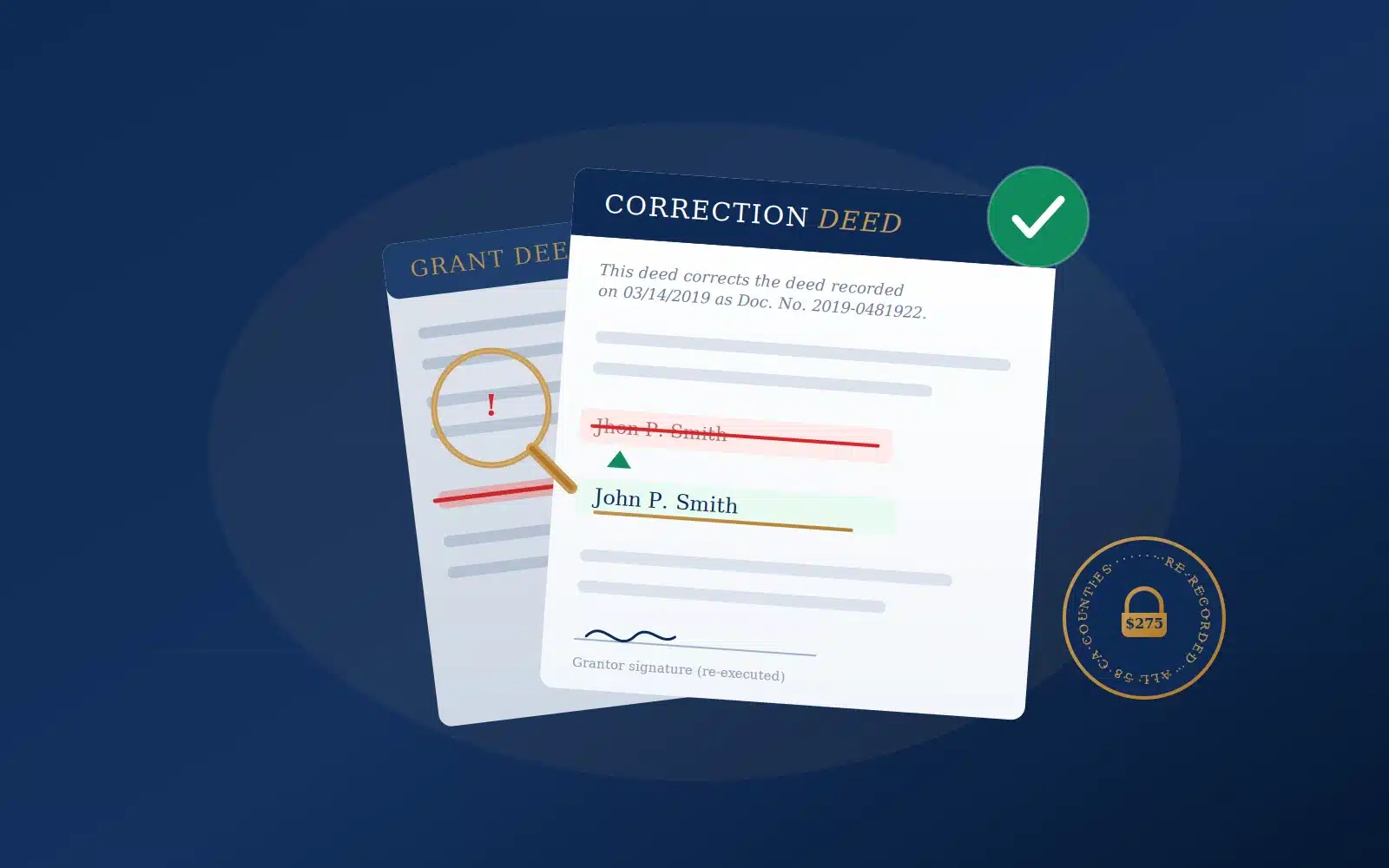
Correction Deed · California title correction & re-recording
California correction deed:
fix the error before it clouds your title
The two errors we fix most: your own name misspelled on your deed — usually signed by you, no former owner needed — and a wrong legal description or APN flagged by title or escrow. Send a copy of the recorded deed (or we pull it for $30), tell us the error and the document you’ve chosen, and we prepare and re-record it for $350, plus your county’s recording fee.
After you submit the intake form, we review it and follow up if we have any questions. No payment is collected until your contract is signed.
A correction deed is $350 — priced separately from a standard transfer because it references the earlier recording — plus your county’s recording fee and any add-ons you select. Typical turnaround is one to two business days from signing. See all deed fees →

About Quinnie Do
Registered Legal Document Assistant · LDA #268 · Santa Clara County
Quinnie Do founded TruPoint Legal LLC and holds three California professional credentials: Registered Legal Document Assistant, Commissioned Notary Public, and Registered IRS Tax Preparer. She works directly with clients in English, Vietnamese, and Cantonese, with Spanish available through our office partner across 50 California counties.
On corrections: Quinnie prepares and re-records corrective documents that fix misspelled names, wrong legal descriptions, and missing signatures on already-recorded documents — handled remotely from the San Jose office, with a Spanish-speaking staff partner for Spanish-speaking owners.
Verify LDA #268 ↗ · CALDA Member Profile ↗
Last updated: June 14, 2026
What a California correction deed does, and what it costs
A California correction deed — also called a corrective document — fixes an error on an already-recorded document, such as a misspelled name, a wrong legal description, or a missing signature, without transferring ownership a second time. As of 2026, a real estate attorney often charges $1,000–$2,000 to draft and record a single corrective document. TruPoint Legal fills that gap as a Santa Clara County–registered Legal Document Assistant, LDA #268. Once you tell us the error and the document you’ve chosen, we prepare the correction with the required corrective statement and the original grantor’s signature, and re-record it for $350 plus the county fee. Because it relates back to the original recording, the corrected document is re-recorded with the county, with same-day e-recording available across 50 California counties — prepared by Quinnie Do, LDA #268 (verify ↗).
Who we prepare correction deeds for
Built for the deed error that’s holding things up
Homeowners
If you recorded a deed yourself and later spotted a typo, a misspelled name, or the wrong legal description, we prepare the corrective document that puts the record right for $350.
Buyers & sellers in escrow
If escrow or the title company flagged a defect on a prior recording and the closing is on hold, we prepare and re-record the fix fast so the file can move.
Heirs & trustees
If the document that passed property to a trust or heir names the wrong party or trust, we prepare the corrective document so title reflects what was intended.
Owners refinancing
If a lender won’t fund a refinance until the recorded document reads correctly, we prepare and re-record the correction so the loan can close.
Attorneys & realtors
If you need a clean correction drafted and re-recorded quickly while you stay on the matter, hand the document work to a registered LDA for $350 per correction.
Why the error matters
An unfixed deed error can stall your next sale or refinance
A recorded title is the public record of who owns the property and exactly what they own. When that record is wrong, the problem doesn’t surface until it’s urgent — a title search before a sale, an underwriter reviewing a refinance, or a probate that depends on a clean chain of title. Until it is recorded, the corrective document stays unfiled and the error remains on the public record and can hold up the transaction.
Common errors we correct:
- A misspelled or wrong grantor or grantee name
- A wrong or incomplete legal description, or a copied-wrong parcel number
- A missing signature or a defective notary acknowledgment
- The wrong vesting wording for how title is held
- A missing or incorrect return address on the recorded document
California offers more than one path — a full correction, a corrective affidavit for minor clerical slips, or a re-recording — depending on the error. You identify what’s wrong; we prepare the corrective document you direct, built to record correctly the first time.

Find your situation
If your deed has this error, here’s what we prepare
Misspelled or wrong name
You need a correction that restates the correct name and references the original recording by its date and document number. If the seller’s name is wrong, the original grantor re-signs. If your own name as the buyer was misspelled, the usual fix is a deed from you naming yourself both ways (“also known as”), so title links the two names. Either way, $350.
Wrong legal description
You need a corrective document carrying the corrected legal description or parcel number, so the record matches the property actually conveyed. We prepare and re-record it for $350.
Missing signature or notary
You need the document re-executed and re-recorded with a proper notary acknowledgment. We prepare the corrective document and arrange notarization so it records cleanly.
A minor clerical slip
You need a lighter fix — a corrective affidavit can address things like an illegible word or a missing return address. We prepare the corrective document you direct.
It actually changes the deal
You need a new deed, not a fix — adding or removing an owner is a real transfer. We prepare the right instrument, such as a California quitclaim deed or an interspousal transfer deed.
What we need from you
You send a copy of the recorded deed (or we pull it for $30), the error, and the document you’ve chosen. We prepare it and re-record it correctly.
What a California correction deed costs
How $350 compares: a California real estate attorney typically charges $1,000–$2,000 to prepare and record a single corrective document, with any consultation billed separately. As a registered Legal Document Assistant with published fees, we deliver the same legally correct paperwork for a fraction of that.
| Optional add-on | Fee |
|---|---|
| Same-day e-recording | +$50 |
| Notary, per signature | +$15 |
| Title search (pull the original recorded document) | +$30 |
County recording and re-recording fees are set by the county and depend on the document and page count. We confirm the exact amount up front and remit it to the Clerk-Recorder on your behalf — it is not part of our $350 fee. A correction deed does not transfer ownership for value, so documentary transfer tax does not apply.
What goes wrong when a correction is filed without help
Form sites and AI tools generate a document from what you type — they can’t catch the things that get a correction rejected or that quietly make the title problem worse. Here’s what we see, and what it costs.
Wrong corrective method
Using a correction where an affidavit was needed, or the reverse, depending on the error.Consequence: the recorder rejects it, and the error stays on the public record.
Missing the original grantor’s signature
A correction to a recorded document generally has to be re-signed by the original grantor.Consequence: the correction won’t record, and the fix stalls.
Incomplete reference to the original
It must name the original recording by its date and document number on the cover page.Consequence: the recorder bounces the cover sheet for corrections.
Trying to change the deal
Using a “correction” to add or remove an owner or change the price.Consequence: it creates a title defect instead of fixing one.
Copying the legal description wrong again
Re-typing a long legal description by hand and introducing a new error.Consequence: a second corrective filing later — more cost, more delay.
How it works
From the error you spotted to a re-recorded deed
Tell us the error
Complete the short intake: what the recorded deed gets wrong and the corrective document you’ve chosen. Attach the recorded deed or the title company’s note if you have one.
Prepare the correction
We draft the correction with the corrective statement, the reference to the original recording, and the corrected information, then arrange the original grantor’s signature and notarization.
Re-record it
We re-record the corrected document with the county and email your stamped copy — typically 1–2 business days from signing, with same-day e-recording where the county accepts it.
A registered, bonded, government-verifiable LDA
Related deed services
When you need a transfer, not a correction
All California deed transfer & recording → · California living trust preparation →
What clients say
Verified Google reviews
I have been working with Quinnie for an Interspousal Deed Transfer. I was very impressed by the service provided. Quinnie was very responsive, knowledgeable and efficient. Highly recommend!
Quinnie was extremely knowledgeable and responsive. She took the time to understand my needs and explained the process in detail before we proceeded. She had all the paperwork prepared and filed on the same day I came in to sign, making the entire process quick, smooth, and seamless.
TruPoint Legal was very professional and clearly explained the process of what I was trying to accomplish. Quinnie was very knowledgeable and help me through the whole process. Will be using them for all my property projects.
Same-office notary
Your corrected deed has to be notarized
Need the correction re-signed and notarized? A corrected document has to be signed before a notary before it can re-record. Our same-office partner, Fingerscan Digital, handles in-office and mobile notary, so the re-signing and re-recording move in one step.
Common questions
California correction deed FAQ
What is a correction deed in California?
A correction deed, also called a corrective deed, is a recorded document that fixes an error on an already-recorded California deed — such as a wrong name, a wrong legal description, or a missing signature — without transferring ownership again. It references the original recording by its date and document number and states the correction, so the public record matches what the parties intended.
How do I fix a misspelled name on a recorded deed?
You record a corrective document that restates the name correctly and references the original recording. We prepare it for the original grantor to re-sign before a notary, then re-record it with the county so the corrected name joins the chain of title, for $350 plus the county fee. If the misspelled name is yours as the buyer, the usual fix is a deed from you identifying yourself by both the incorrect and correct names (“also known as”).
How much does a correction deed cost in California?
A correction deed is $350, whether the property is held by individuals, a trust, or an LLC or corporation. That includes drafting the corrective document, the reference to the original recording, and one revision. The county’s own re-recording fee is set by the county and is collected and remitted on your behalf.
Does a correction deed change ownership or trigger a reassessment?
No. A correction deed only fixes an error on the existing record — it does not convey a new interest, and it relates back to the original recording. Because there is no change in ownership, it is not treated as a transfer for value and does not, on its own, trigger a property tax reassessment.
Do I need the original grantor’s signature to correct a deed?
Usually, yes. A correction to a recorded deed generally has to be re-signed by the original grantor and notarized before it can be re-recorded. We prepare the document and arrange notarization so the signature requirement is met and the correction records cleanly.
What is the difference between a correction deed and a corrective affidavit?
A correction deed re-states and re-records the document to fix the error. A corrective affidavit under Government Code §27201 is a sworn statement that can fix only four things: a missing or wrong return address, illegible text, a wrong printed name near a signature, or a wrong documentary transfer tax amount. A scrivener’s affidavit, signed by whoever drafted the deed, explains a mistake but does not change the deed itself. Anything more, such as a misspelled name or a wrong legal description, needs a correction deed. You identify the error; we prepare the corrective document you direct.
Can you fix a wrong legal description on my deed?
Yes. We prepare a corrective document carrying the corrected legal description or parcel number, referenced to the original recording, so the public record matches the property actually conveyed. A wrong legal description is one of the most common reasons a document has to be corrected before a sale or refinance can close.
How long does it take to correct and re-record a deed?
We prepare most corrections within 1–3 business days. After the original grantor signs before a notary, we re-record the corrected deed with the county and email your stamped copy — typically 1–2 business days from signing, with same-day e-recording in the counties that accept it.
My title company found an error before closing — can you fix it fast?
Yes. Title and escrow holds before a closing are one of the most common reasons clients come to us. We confirm the exact defect the title company flagged, prepare the corrective document, and re-record it quickly so the file can move toward closing.
The county recorder rejected my deed. Is that the same as needing a correction deed?
No, and the difference matters because one is far cheaper than the other. A rejected deed never recorded, so there is nothing to correct — we simply prepare a compliant version and record it. A correction deed is for a deed that already recorded with an error in it, where the public record now has to be fixed. Send us the rejection notice or the recorded deed and we will quote the correct fee before you pay, since the price is different.
Can I just re-record the original deed with the correction written in?
Please do not. Writing on a recorded instrument and re-recording it is one of the fastest ways to create a title problem, because it is unclear on the face of the record what changed, when, and on whose authority. Counties also reject marked-up re-recordings routinely. California practice is to record a properly drafted corrective instrument that identifies the original document by its recording reference, states precisely what is being corrected, and is executed and acknowledged properly. That is what makes the fix visible and defensible to a future title examiner.
Can I use a free correction deed form off the internet?
This is the one document where we would push back hardest. A correction is a second instrument that has to reference the first by its exact recording date and instrument number, state the error and the correction unambiguously, and be signed by the right party — which is not always the person who owns the property now. Free templates do none of that reliably. A badly drafted correction does not clean the record; it adds a second confusing document to it, and the next title examiner has two problems instead of one.
Can you handle this if I live out of state or outside the country?
Yes, at the same $350. From another state, you sign before any notary public licensed where you live. From outside the country, the acknowledgment is normally taken at a U.S. embassy or consulate, and California also accepts a notary of that country, though some counties want the signature authenticated first. We confirm which route your county accepts before you book an appointment.
The error is on a deed from years ago and the person who signed it has died. Can it still be fixed?
Often, yes, though the route depends on the error. Some defects can be addressed by an affidavit from someone with knowledge of the facts rather than a new signature from the original grantor. Others need a fresh conveyance from whoever now holds the interest, which is a different document. And if the deceased signer is also the reason title has not been cleared, you may need an affidavit of death first. Once you select the document you want prepared, we confirm the fee before any work begins.
What do you need from me to prepare a correction deed?
A copy of the recorded deed containing the error, or the recording date and instrument number so we can pull it; a clear description of what is wrong and what it should say; and, where the legal description is the problem, the correct description from an earlier recorded deed or the title report. If a title company flagged the defect, send us their written note — it is usually the fastest path, because it tells us exactly what they need to see. Intake takes about ten minutes and nothing is charged until we confirm your fee.
Do I need an attorney to correct a recorded deed?
Not for the document itself. Preparing and recording a corrective instrument is document work, which a California Registered Legal Document Assistant is authorised to do at your direction under Business and Professions Code section 6400. TruPoint Legal is LDA #268, Santa Clara County, registered and bonded, and does not give legal advice. Where you do want a lawyer is when the error is disputed rather than clerical — someone contends the deed should never have been recorded, the parties disagree about what the correction should say, or a lender or title insurer is asserting a claim against the title. A defect everyone agrees on is paperwork; a defect people are arguing about is litigation and belongs with a licensed attorney.
Get the error off your title
Tell us what the recorded deed gets wrong and the document you’ve chosen in a 10-minute intake. We confirm your total fee before any work starts — $350 plus the county’s recording fee.